
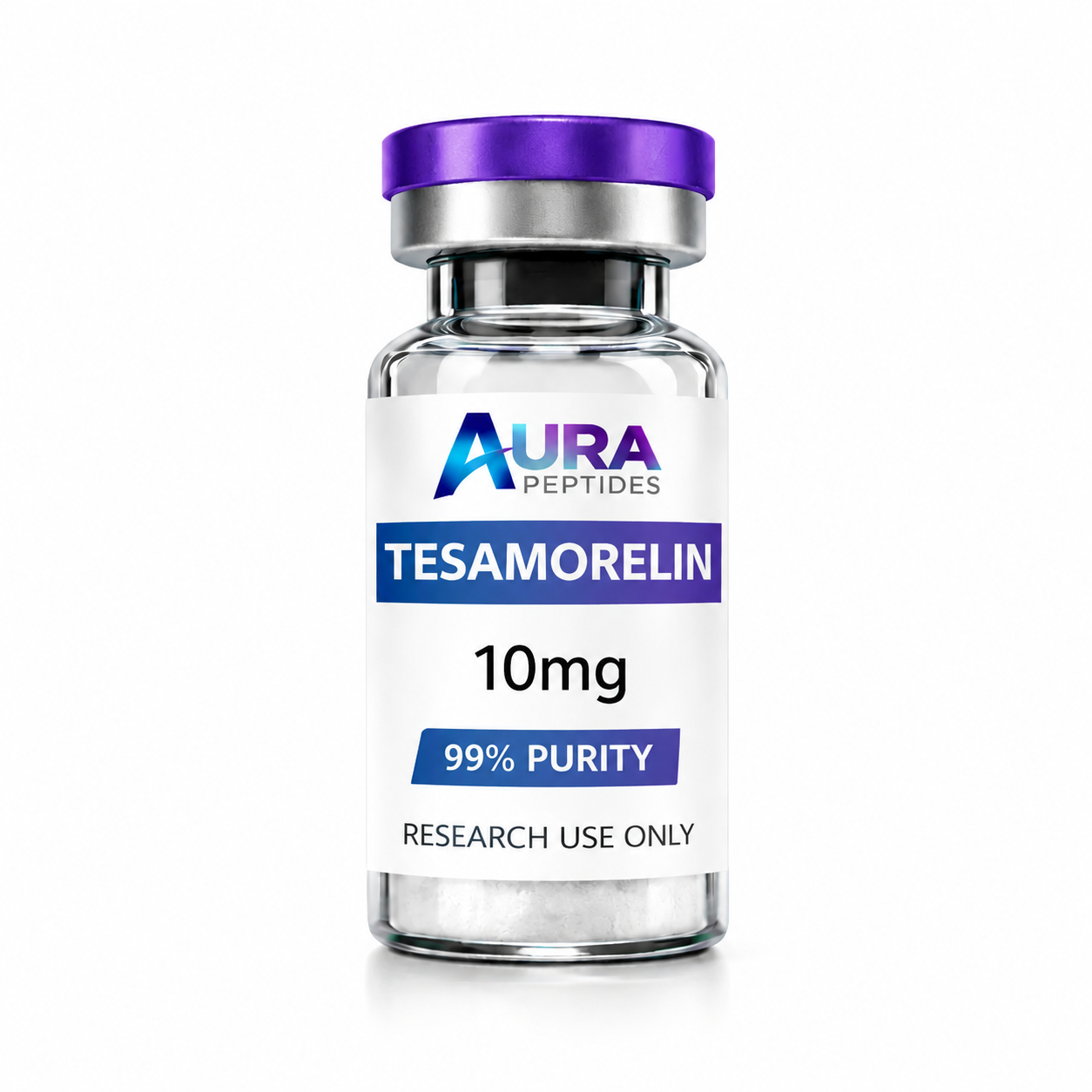
Tesamorelin 10mg Vial | Aura Peptides Official UK
The Tesamorelin 10mg Vial by Aura Peptides is a high-purity, synthetic growth hormone-releasing hormone (GHRH) analogue engineered for advanced endocrine evaluation, pituitary axis stimulation assays, and visceral lipid metabolism research in the UK. Supplied as a vacuum-sealed, lyophilized powder, this 10mg formulation provides researchers with optimal peptide stability and precise reconstitution control for quantitative laboratory protocols.
Every batch of Aura Peptides Tesamorelin 10mg is produced under strict analytical quality control and independently tested using High-Performance Liquid Chromatography (HPLC) and Mass Spectrometry (MS) to guarantee purity ratings exceeding 98.0%.
Technical Specifications: Tesamorelin 10mg Research Vial
| Parameter | Technical Specification |
| Product Identifier | AURA-TESA-10V |
| Active Sequence Content | 10 mg lyophilized powder per vial |
| Physical Appearance | Lyophilized white cake/powder |
| Peptide Class | Synthetic Growth Hormone-Releasing Hormone (GHRH) Analogue |
| Purity Grade | $\ge$98.0% (Verified by HPLC & MS) |
| CAS Number | 218949-48-5 |
| Molecular Formula | $\text{C}_{221}\text{H}_{366}\text{N}_{72}\text{O}_{67}\text{S}$ |
| Molecular Weight | ~5135.9 g/mol |
| Storage Parameters | Store un-reconstituted at -20°C; store reconstituted solution at 2°C to 8°C |
Key Research Applications of Tesamorelin
Tesamorelin is a stabilized 44-amino-acid peptide featuring a trans-3-hexenoic acid modification at the N-terminus, which enhances resistance to enzymatic degradation by dipeptidyl peptidase-IV (DPP-IV). It is widely studied in metabolic and endocrine research:
-
Endogenous GH Axis Activation: Investigated for its ability to bind pituitary GHRH receptors, stimulating pulsatile growth hormone (GH) secretion without disturbing basal cortisol or thyroid pathways.
-
Visceral Adipose Tissue (VAT) Research: Extensively evaluated in cellular and metabolic models for its capacity to promote lipolysis and selectively reduce visceral fat accumulation.
-
IGF-1 Downstream Signaling: Researched for upregulating hepatic Insulin-like Growth Factor 1 (IGF-1) production and its role in cellular proliferation and lipid turnover.
Reconstitution & Laboratory Handling Protocols
To protect the structural integrity of the 44-amino-acid peptide chain during laboratory preparation:
-
Temperature Equilibration: Allow the freeze-dried vial to reach room temperature before adding liquid diluent to avoid thermal shock.
-
Diluent Introduction: Gently inject Bacteriostatic Water or Sterile Saline along the inside glass wall of the vial rather than directly onto the lyophilized powder.
-
Gentle Dissolution: Swirl the vial in smooth, circular motions until completely dissolved. Avoid vigorous shaking, as mechanical agitation can shear delicate peptide bonds.
Quality Control & Analytical Documentation
At Aura Peptides Official UK, batch integrity and chemical purity are rigorously confirmed prior to distribution:
-
High-Performance Liquid Chromatography (HPLC): Confirms single-peak baseline separation and verifies zero synthesis side-products or truncated sequences.
-
Mass Spectrometry (MS): Validates exact molecular mass identity ($\text{MW} \approx 5135.9\text{ g/mol}$) against baseline reference standards.
-
Certificates of Analysis (CoAs): Batch-specific CoAs are accessible for verified research users upon request.
Frequently Asked Questions
What makes Tesamorelin different from un-modified GHRH?
Tesamorelin features a trans-3-hexenoic acid group attached to its N-terminal amino acid, which significantly increases its enzymatic stability and plasma half-life compared to native 44-amino-acid GHRH.
How should the Tesamorelin 10mg vial be stored?
Un-reconstituted freeze-dried vials should be stored frozen at or below -20°C, protected from light. Once reconstituted with sterile diluent, store the solution refrigerated between 2°C and 8°C.
Regulatory Compliance Notice
Laboratory Notice: All products supplied by aurapeptides.uk, including Tesamorelin 10mg Vials, are strictly intended for laboratory in vitro research, analytical evaluation, and scientific inquiry. They are not intended for human consumption, clinical administration, medical diagnosis, or therapeutic use.
Be the first to review “Aura Peptides Tesamorelin 10mg vial”
Related products
Reviews
There are no reviews yet.